Agent governance is a runtime problem
Most governance is written before software runs: a policy, an approval, a review. Agents strain that model. The same agent can take different steps on the same input, and its actions happen while it works.
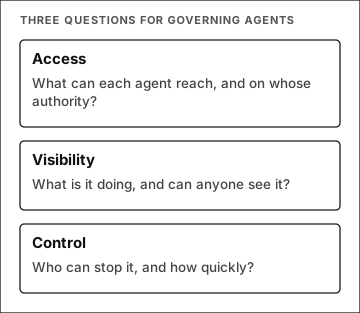
So governing agents has to happen at runtime: authorization scoped to each task, a trace of what the agent did, monitoring while it acts, a quick way to revoke access and a way to recover when something goes wrong. It comes down to three questions.
Most of the parts already exist
Identity and access tools issue scoped, short-lived credentials, and standards such as OAuth 2.0 token revocation define how to cut access off.[1] Security teams already automate a lot of detection and response, and logging and observability tools record what systems do.
OWASP’s guidance on excessive agency in LLM applications points to the same controls: give an agent only the tools and permissions it needs, and require human approval for high-impact actions.[2]
The missing piece is the task
The gap, if there is one, is in tying these together around an agent’s task. Existing tools mostly see a service account making calls. They may not see that the calls belong to one agent run, on whose behalf it acted, which step it had reached, or how to undo the three things it already changed when it is stopped halfway.
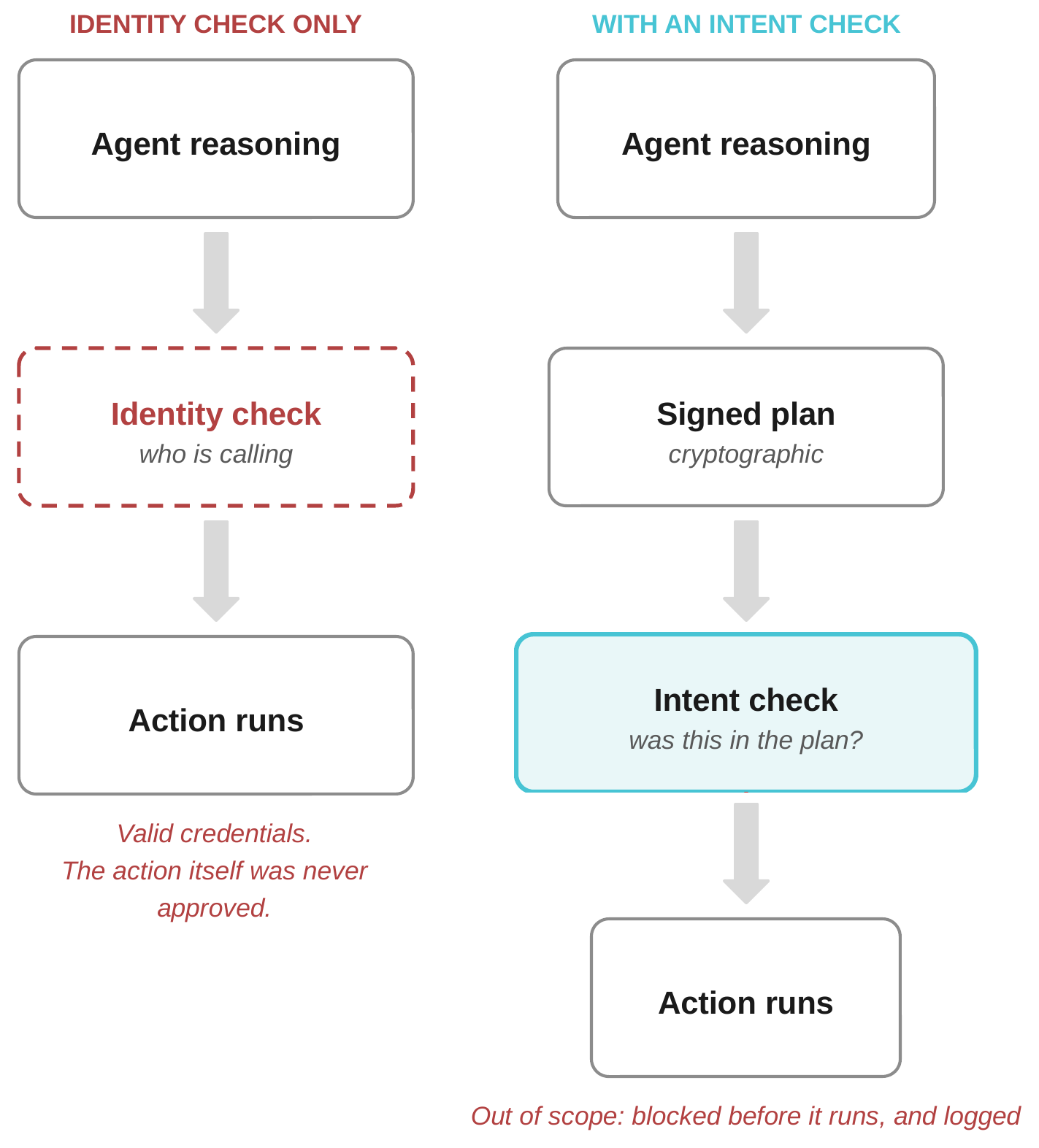
One way to close part of that gap is to check the action as well as the caller. An identity check confirms who is calling. An intent check asks whether this particular action was in the plan approved for this task, and in that design an out-of-scope action is stopped before it runs.
Recovery is the least solved part
Revoking a credential stops new actions but doesn’t reverse finished ones. Cheaper models help attackers and defenders at once, which raises the stakes, but I don’t have numbers on how fast either side is moving, so I’m not leaning on that here.
Security, risk and platform teams, who already own access and incident response, are the natural buyers. They may never need a separate product. Identity, security and observability vendors could extend what they sell to cover agents, and governance would become a set of features in tools companies already run.
I’d drop this if companies running many agents in production can answer the three questions with their existing stack, including stopping an agent mid-task and undoing its partial work.
Notes:
-
IETF, “RFC 7009: OAuth 2.0 Token Revocation,” 2013. ↩︎
-
OWASP GenAI Security Project, “LLM06:2025 Excessive Agency.” ↩︎