The conversation becomes the interface
For most of the web’s history, a business reached a customer through a page the customer opened. More of that contact is starting to happen inside conversations: a person asks an assistant in a chat or message thread, and the assistant finds, compares and sometimes acts.
For that to spread, assistants need distribution where people already spend time, and businesses need to expose their catalogs, prices and actions in a form an agent can use.
Search splits by who is asking
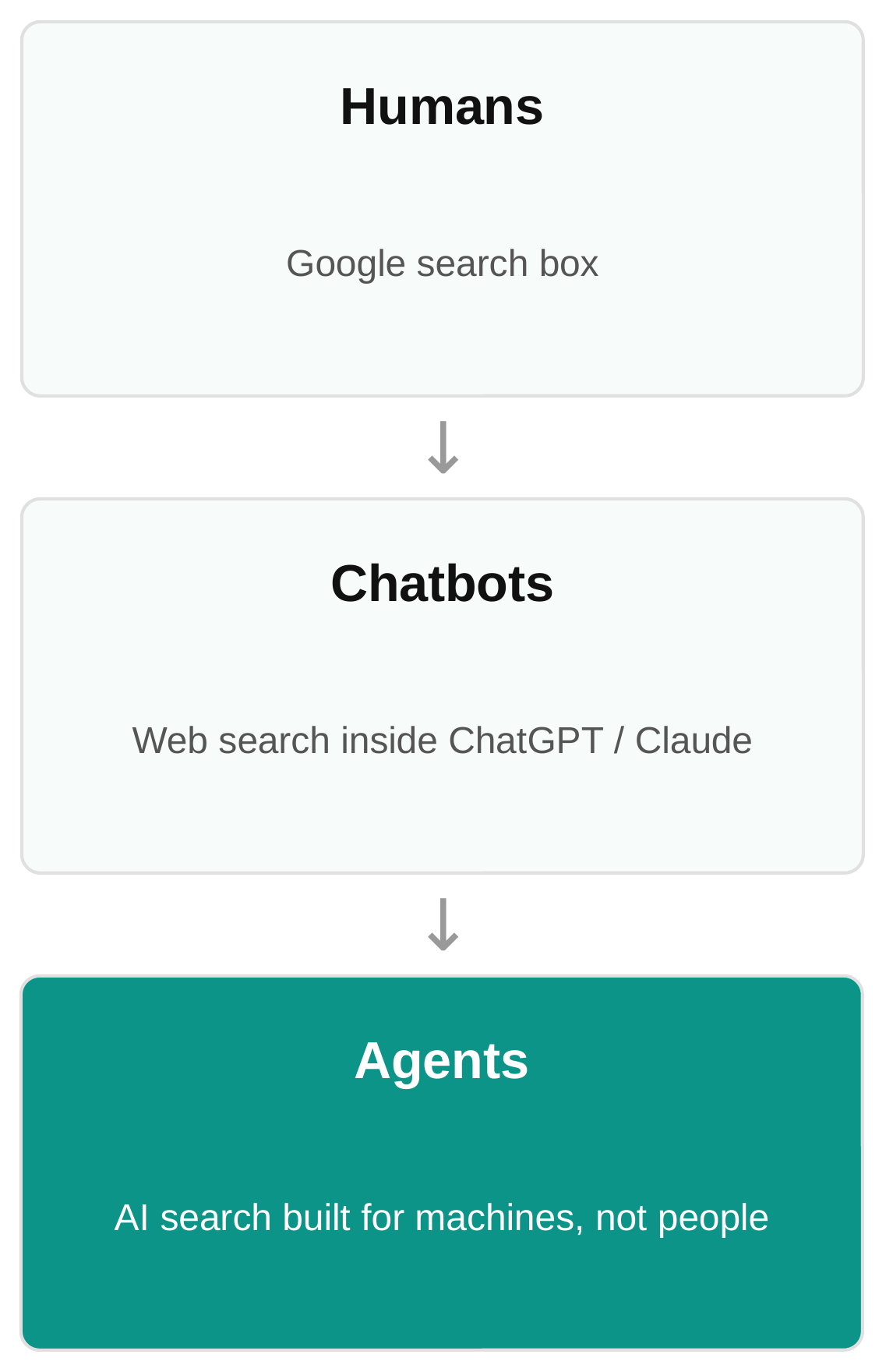
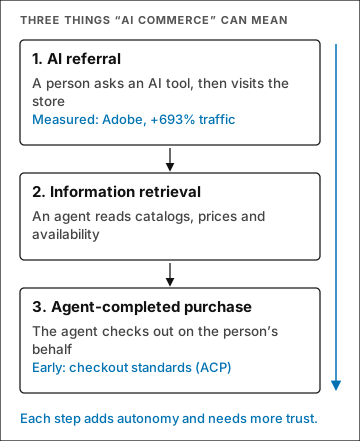
Three behaviors often get lumped together here. Retrieval is an assistant answering a question with information from the web. A referral is a person clicking from that answer through to a business. An autonomous purchase is the agent completing the transaction itself.
Each asks something different of a business, and the evidence for each is very different.
Referrals are measured; purchases are early
The clearest number so far is about referrals. Adobe measured traffic to US retail sites from generative AI tools over the 2025 holidays.[1]
+693%
That is people starting in an AI tool and then visiting a store. It says nothing about agents buying on their own.
The action side is earlier. The Agentic Commerce Protocol is an open standard for checkout between buyers, AI agents and businesses, in which the business stays in control of what it sells.[2] Standards like this show the plumbing being built. Whether people trust agents with their money is a separate question.
Why messaging
Messaging needs no new app or login, and many tasks fit a thread: a quick request, a confirmation, a reminder, a simple choice. Detailed comparisons and anything visual fit less well.
I built a small event finder for iMessage that suggests events that fit your calendar. It’s a prototype that shows the shape of the idea, not evidence that people want it.
Businesses that depend on people seeing their interface, through ads, upsells or onboarding, would feel this first. Those that make their products easy for agents to understand and buy could gain, as could whoever runs identity and payments for agent-initiated purchases.
It’s also possible that people keep using assistants for research but still choose and pay on familiar sites, so referrals grow and autonomous purchases stay rare. I’d change my mind if agent-completed purchases stay negligible after checkout standards are widely available, or if messaging platforms close off third-party agents.
Notes:
-
Adobe, “2025 holiday shopping season results,” January 7, 2026. The figure covers Nov. 1 to Dec. 31, compared with a year earlier. ↩︎