Agents can help formulate the optimization problem
Established optimization methods already handle changing conditions. Model predictive control re-solves a plan over a rolling horizon, and stochastic programming accounts for uncertainty.[1]
The opportunity I’m interested in comes before the solver: turning messy operational information into a problem it can solve.
Formulation is the bottleneck
Before anything can be optimized, someone has to decide what the objective is, which constraints are real and which data to trust. That knowledge is scattered across emails, spreadsheets, policies and people’s heads.
The authors of OptiMUS, an LLM-based agent that formulates and solves linear and mixed-integer programs from natural-language descriptions, argue that most such problems are still solved by hand because formulating them takes expertise.[2] The NL4Opt competition was set up to study the same step.[3]
Where agents could help
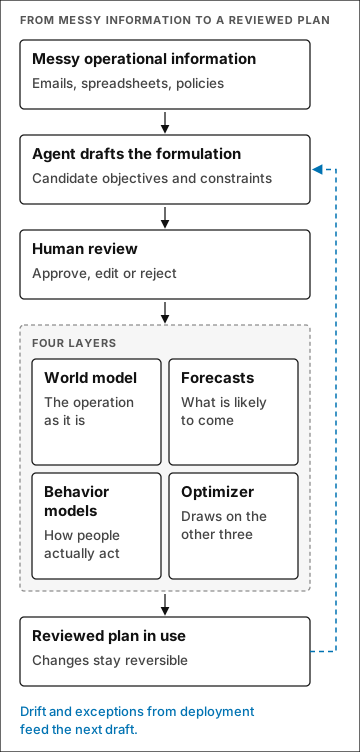
Agents could turn messy information into candidate objectives and constraints, propose revisions when conditions change and explain exceptions, with a person reviewing before anything changes the plan. Results so far come from benchmark problems, not live operations, so I’m not claiming agents do this better than experienced analysts.
One way to structure it is four layers: an operations world model that reflects the operation as it is, forecasts, models of how workers and customers actually behave, and an optimizer that draws on the other three.
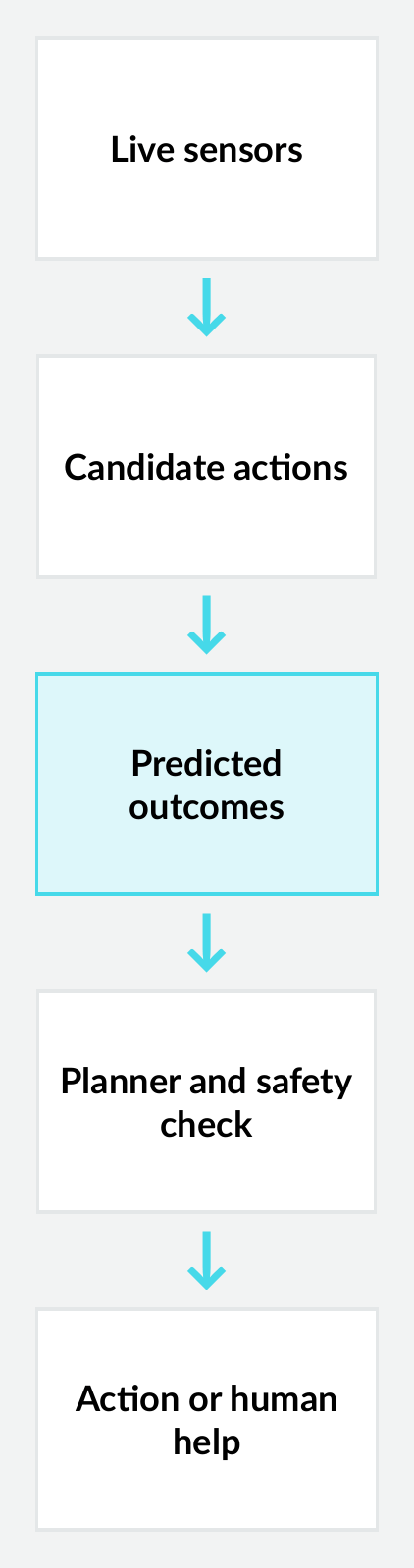
The world-model layer has its own loop once a plan is running. It takes in what sensors report, predicts what each candidate action would do, and lets a planner with a safety check choose one or hand the decision to a person.
How it goes wrong
An agent can encode a rule that doesn’t exist or miss one that does, and the solver will return a confident plan that can’t or shouldn’t be carried out.
A formulation can be right on day one and slowly drift away from how the operation actually works. And a plan can reach people or equipment without anyone checking it. Each of these argues for keeping proposals reviewable and changes reversible.
Planning teams in logistics, manufacturing and scheduling, who already pay for solvers and consultants, are the likely beneficiaries. Formulation may depend on tacit knowledge agents can’t reach, in which case experts still do the real work and agents only save typing. I’d change my mind if, in live deployments, agent-proposed formulations need so much correction that they save analysts no time, or if the errors they introduce outweigh the gains.
Notes:
-
Rawlings, Mayne and Diehl, Model Predictive Control: Theory, Computation, and Design, 2nd ed.; Birge and Louveaux, Introduction to Stochastic Programming, 2nd ed., Springer, 2011. ↩︎
-
AhmadiTeshnizi, Gao and Udell, “OptiMUS: Scalable Optimization Modeling with (MI)LP Solvers and Large Language Models,” 2024. ↩︎
-
Ramamonjison et al., “NL4Opt Competition: Formulating Optimization Problems Based on Their Natural Language Descriptions,” 2023. ↩︎